Category

Braces

Can You Get Braces With a Crown? What You Need to Know

By Braces

Yes, in most cases you can get braces with a crown. If you have invested in a crown, bridge, or implant, it makes sense to worry that braces might ruin that work, or that a “fake” tooth simply cannot be moved. That worry is understandable, and in many cases braces can still work.

For most adults in Carlsbad, having existing dental work does not take braces or clear aligners off the table. It just means your care needs a little extra planning.

This guide walks you through why it works, how crowns, bridges, and implants each behave differently, whether braces or Invisalign is the better fit, the smart way to time treatment, and how your dental work is protected along the way.

Dr. Cameron Hulse is a specialist orthodontist who has cared for Carlsbad smiles since 2007, and coordinating with your dentist is part of how we work.

Quick Answer

Yes. In most cases you can get braces or Invisalign with a crown. A crown covers the visible part of a natural tooth, so if the tooth, root and surrounding tissues are healthy, braces can generally move it and the crown rides along on top. Dental implants are the main exception, because they fuse to the bone and cannot be moved.

The Short Answer: Yes, and Here Is Why It Works

A crowned tooth moves with braces because braces move the root, not the cap on top.

When people picture braces, they imagine the bracket pushing directly on the visible tooth. What actually happens is gentler, slower, and much deeper than that. Force from the bracket or aligner travels down through the tooth into the root, and the real work happens at the periodontal ligament, the thin cushion of tissue between your root and the surrounding bone.

That ligament senses the pressure and signals the bone to remodel, dissolving slightly on one side and rebuilding on the other, so the whole tooth drifts into its new position. You can read more about this root-and-ligament mechanism of tooth movement in the research literature.

Here is why that matters for a crowned tooth. A dental crown is a cap placed over your natural tooth. The natural root underneath it is still held in the bone by its periodontal ligament, and if the tooth, root and surrounding tissues are healthy, that root is what moves. The crown simply rides along on top.

The same logic applies to a tooth that has had a root canal or a filling. A root canal on its own does not necessarily stop a tooth from moving. What matters is the health of the tooth and the tissues around it. When you get braces with a crown, that cap is a passenger, not a roadblock.

Crown, Bridge, or Implant: What Moves and What Does Not

The one distinction that actually changes your treatment plan is what kind of restoration you have. Crowns, bridges, and implants each behave differently under orthodontic force.

A single crown sits on your own natural root. Because that root still has its periodontal ligament, a healthy crowned tooth can generally move just like any natural tooth. This is the most common situation.

A bridge is different. A bridge joins two or more teeth into one rigid unit to fill a gap. Because it is fused as a single structure, the orthodontist cannot tip or rotate one tooth in a bridge independently of the others. We plan movement around the bridge, and occasionally, if that area truly needs to shift, your dentist may section or remake the bridge as part of the coordinated plan.

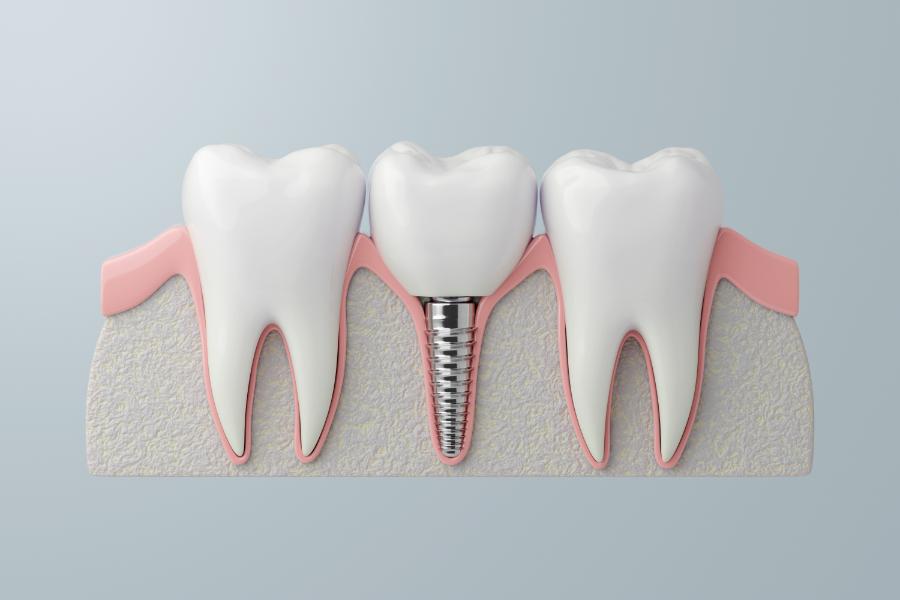
A dental implant is the one restoration that cannot be moved. An implant is fused directly to your jawbone with no periodontal ligament between them, so there is no ligament to signal the bone to remodel. As the research on osseointegrated implants confirms, an implant behaves like a fixed anchor. We design treatment to move the natural teeth around it, and implants are usually placed after straightening, once there is a properly aligned space for them. Because an implant stays put, it can sometimes serve as a stable anchor for moving natural teeth.

One honest note. We are your orthodontist, so we move the teeth. We do not place bridges or implants. Your general dentist handles that restorative work, and we coordinate with them closely.

Braces vs. Invisalign When You Have a Crown

Both braces and Invisalign work with crowns. Invisalign just sidesteps the one small complication a crown creates.

Traditional metal and ceramic braces bond brackets directly to your teeth. A crown’s porcelain or zirconia surface is smoother and slicker than natural enamel, so orthodontists use a special conditioning step and adhesive to bond brackets to crowns. Even then, a bracket on a crown may come loose more often than one on natural enamel, which may mean an occasional re-bonding visit.

Invisalign can be an option with crowns, because aligners do not need a bracket bonded to the crown. When small tooth-colored attachments are needed, they can often be placed on natural teeth rather than the crown; your orthodontist will plan this.

Which option is right for you depends far more on the movement your smile needs than on the crown itself.

  • Braces may be better for complex bite corrections or severe crowding.
  • Consider Invisalign if you want a removable option, easier cleaning around crown margins, and fewer bonded surfaces.

We will walk through both at your consultation and recommend the fit that makes the most sense for your teeth.

Timing: Should You Straighten First or Get the Crown First?

When you have a choice, straightening first and finalizing the crown afterward usually gives the best result.

There is an important exception. If a tooth urgently needs a crown because it is cracked, badly decayed, or has just had a root canal, protect the tooth first. Your dentist can place the crown right away, and a well-made crown can still be moved into place later during your orthodontic treatment. Tooth health always comes before scheduling convenience.

When the crown is elective and not urgent, straightening first is often the smarter sequence. Once your teeth have settled into their final positions, your dentist can craft a crown or veneer that fits your new alignment and matches your smile perfectly. A crown made beforehand is shaped to fit the old position, and once the tooth moves, it may no longer seat, bite, or blend correctly, which can mean paying to remake it. Straighten first, and the crown is made once, and made to fit.

The key to getting this right is coordination between your orthodontist and your restorative dentist. Bring up any planned crown work at your consultation so we can map out the ideal order together.

How Your Dental Work Is Protected During Treatment

Protecting your existing dental work starts before a single bracket goes on and continues through the day they come off.

First, every crown and restoration should be sound. Your dentist repairs or replaces a loose, worn, or failing crown before anything is bonded to it, since bonding to a compromised crown can dislodge it. This quick check up front prevents most problems.

During treatment, your orthodontist may move a crowned tooth a little more gently and watch the bond and the crown margins. The moment that calls for the most care is removing brackets at the end, and removing brackets from restored teeth takes extra care.

If a bracket comes loose, call our office right away and keep the piece to bring to your repair appointment. If a crown comes loose, keep it and contact your dentist promptly, and let us know too.

Good hygiene matters too. Braces trap more plaque, and the spot where a crown meets your natural tooth is already prone to decay, so extra brushing and flossing there pays off. The division of labor is simple. We move the teeth, your dentist maintains and repairs the crown, and together we protect your investment. When treatment ends, retainers hold everything, crowns included, right where it belongs.

Frequently asked questions

Will my crown get damaged by braces?
A sound crown is less likely to be damaged. Orthodontists use special adhesives to bond brackets to crowns, and the root beneath the crown does the moving. The main risk comes from a crown that is already loose, old, or worn, which is why your dentist should check it before treatment starts.
Will my crowns need to be replaced after braces?
Sometimes. Many crowns come through treatment fine and stay right where they are. Front crowns are occasionally updated afterward so the shade and shape match your newly aligned smile. That call belongs to your general dentist, who handles all crown work, not to the orthodontist.
Can I get Invisalign if I have a crown?
Yes, Invisalign can be an option with crowns, because aligners do not need a bracket bonded to the crown. When tooth-colored attachments are required, they can often be placed on natural teeth rather than the crown surface; your orthodontist will plan this.
Does having a crown make treatment take longer?
It depends on your case. A crowned tooth may occasionally be moved a bit more slowly and monitored more closely, but overall timing is driven mainly by how complex your case is.
Do I still need to see my regular dentist during braces?
Yes, please keep your regular dental checkups and cleanings throughout treatment. Braces trap more plaque, especially around crown margins, so professional cleanings matter more, not less. Think of it as a team effort. Your dentist maintains your crowns and overall dental health while we handle straightening your smile.

Questions about your braces or Invisalign?

Whatever’s on your mind, our Carlsbad team is happy to help, no judgment, just straight answers and a plan for a healthy smile.

Prefer to call? (760) 448-1344

This article is for general educational purposes only and is not a substitute for professional dental or orthodontic advice. Crown, bridge, and implant work is provided by your general dentist. Always consult your orthodontist and dentist about your treatment.

Removing Teeth for Braces: Do You Really Need It?

By Braces

Few words on a treatment plan cause more dread than “extraction.” If you have just been told, or you suspect, that braces might mean losing healthy teeth, that anxiety makes sense. The reassuring truth: most people do not need removing teeth for braces at all, and when it is recommended, the decision is deliberate and carefully planned, never routine or arbitrary.

This guide covers when extraction is actually needed, who does what, whether it changes your face, and what recovery looks like. Whether you are weighing traditional metal braces or clear aligners, we want you walking into your Carlsbad consultation informed and calm, not scared.

Quick Answer

Most people do not need teeth removed for braces, especially with mild to moderate crowding. When extraction is recommended, your orthodontist plans it and a dentist or oral surgeon performs it. How often it happens varies widely between practices and patients. Extraction can change your lip position and profile, but it does not automatically leave your face sunken; the effect depends on your starting profile, diagnosis and plan.

Do You Actually Need Teeth Pulled for Braces?

Most articles bury the reassuring part: for most patients, the answer is no. Especially with mild to moderate crowding, many people straighten their teeth without losing any. Extraction is the exception, not the rule.

How often is it actually needed? Real clinic data helps. A peer-reviewed study of 2,184 patients treated at one US university orthodontic clinic (the University of North Carolina, 2000 to 2011) found extraction rates fell from about 37% in 2000 to just under 25% from 2006 onward. A separate peer-reviewed study of 542 Class I patients treated in Greece landed close by, at 26.8%. So the commonly repeated “about a quarter of cases” figure describes those two study populations, not a fixed law. Rates vary widely from practice to practice and patient to patient, so no honest orthodontist can tell you your odds before seeing your teeth.

Crowding, how far the front teeth protrude and the type of bite problem all feed into the decision. Mild to moderate crowding is often solved without removing anything. As crowding grows more severe, or when the front teeth stick out significantly, removing a tooth or two can become the healthiest long-term fix, because there simply is not enough room in the jaw for every tooth to line up. Whether extraction is appropriate depends on the individual diagnosis and treatment goals.

Who Actually Removes the Teeth? (It Isn’t Your Orthodontist)

1

Your orthodontist

Examines your teeth and builds the plan, deciding if any teeth need to come out. Most cases need none.

2

An oral surgeon or dentist

Performs the extraction itself, only if the plan calls for one. It is a separate, quick appointment.

3

Your orthodontist

Guides the remaining teeth into the new space with braces or Invisalign, closing the gap.

Who does what when braces treatment involves an extraction.


Almost no one explains this clearly, and hearing it settles a lot of worry: the orthodontist and the person who performs an extraction are usually two different people.

The orthodontist’s job is diagnosis and planning. Dr. Cameron Hulse, a specialist orthodontist, is the one who decides whether extraction is truly needed, exactly which teeth and how many, and how the timing fits into your full treatment plan. What he does not do is pull the teeth himself. If your plan includes an extraction, a dentist or oral surgeon performs it, and Dr. Hulse then guides your teeth into the new space with braces or Invisalign.

That split is a benefit, not a gap. You get a specialist directing the strategy and the right expert handling each hands-on step. Extractions are usually done under local anesthetic, and the decision behind one comes from your x-rays, photos, and scans. It is coordinated care, with your plan built first and every provider working from the same blueprint.

Will Removing Teeth for Braces Change My Face?

This is the fear that keeps people up at night, and it deserves an honest answer rather than a brush-off. Plenty of people worry, and read online, that pulling premolars will flatten their profile, sink their cheeks, or “dish in” the face. Those stories circulate widely, and the concern is fair to take seriously.

The evidence on appearance is reassuring. A 2017 systematic review in the Journal of the American Dental Association (JADA) based on a small number of studies, found no significant difference in facial-profile esthetics between treatment with and without premolar extraction. The reviewers noted that a patient’s starting lip position, not the extraction itself, is what helps guide these borderline decisions. In other words, blaming facial changes on premolar extraction alone oversimplifies what actually happens. Outcomes depend on your starting profile, the diagnosis and the skill of the plan, not on the extraction alone.

The goal in a well-planned case is facial harmony, not flattening. When teeth are removed to relieve severe crowding, the face may change very little; when the aim is bite correction, more noticeable lip and profile changes are possible, and a good plan works with your features rather than against them.

One honest note on the airway and sleep-apnea claims you may have seen: current evidence does not support a general link between premolar extraction and breathing problems, and it remains an area of ongoing discussion. We will not overclaim in either direction. All of this underlines why careful diagnosis and planning matter so much.

Which Teeth Are Usually Removed, and How Many?

If extraction is on the table, most patients want to know exactly what is at stake. The teeth removed most often are the first premolars, also called bicuspids, the ones sitting just behind your pointed canines. Taking them from the middle of the arch creates space right where crowding tends to be, so the remaining gap closes neatly.

How many is usually a symmetrical set. Often that means up to four, one on each side of the top and bottom, though some cases need only one or two. The exact number depends on your bite and crowding, not a template:

  • Most common: the first premolars behind the canines
  • Typical range: 1 to 4 teeth, usually removed symmetrically
  • Wisdom teeth: a separate issue, removed for their own reasons and not counted here

For certain bite problems, an orthodontist may target different premolars instead. Correcting a Class II or Class III bite without jaw surgery, for example, can call for a specific pairing of upper and lower premolars, planned case by case. Which teeth and how many always come from your individual plan and imaging, worked out before any braces go on.

Ways to Avoid Pulling Teeth in the First Place

Before extraction ever enters the conversation, there are gentler ways to make room, and they are often worth considering first when a case allows.

One is interproximal reduction, or teeth shaving. It smooths tiny, controlled amounts of enamel between teeth, no more than a fraction of a millimeter per surface, to open space for mild to moderate crowding. Available studies, though limited, have not shown a higher risk of cavities or gum problems when it is done properly. Ask your orthodontist whether it suits your case.

Another is arch expansion. In growing kids and teens, expanders and other appliances can widen the arch and guide jaw development, sometimes reducing or removing the need for extraction later. This is where early, Phase 1 treatment pays off. It works best while the jaw is still growing, and the lower arch has real limits, so it is not right for every case.

Invisalign fits in here too. When extraction genuinely is needed, aligners can still close the space, using attachments on the canines and back teeth for control. Space closure is more technically demanding with aligners than with braces, and for some cases braces may be the better choice. For severe crowding or significant protrusion, extraction is often still the most reliable option. The point is that extraction is one option among several, used when the diagnosis calls for it.

What Recovery Is Like After an Extraction

If a tooth does come out, recovery is usually a short, manageable step rather than the ordeal people brace for. Your orthodontist will tell you how long to wait after a simple extraction before braces go on or are adjusted at that site. More complex or surgical extractions, like impacted teeth, can take longer. Your provider sets the exact pace.

The first few days bring some soreness, handled with the aftercare instructions your dentist or surgeon gives you. Stick to soft foods and stay gentle around the site while it settles. Mild soreness and minor swelling for a few days are normal, but call your provider promptly if you notice severe or worsening pain, heavy bleeding, or signs of infection.

Once treatment gets rolling, that space is used strategically to straighten everything around it. By the end, most patients honestly forget which teeth were ever removed. It is one brief chapter in a much longer smile journey, and the cost and timing of that journey are things we walk through openly during your cost of treatment conversation.

Questions about your braces or Invisalign?

Whatever’s on your mind, our Carlsbad team is happy to help, no judgment, just straight answers and a plan for a healthy smile.

Prefer to call? (760) 448-1344

Frequently Asked Questions

Will I definitely need teeth pulled for braces or Invisalign?

Most likely not. Most patients, especially those with mild to moderate crowding, straighten their teeth without any extraction. Two clinic studies, one at a US university clinic and one of Class I patients in Greece, found rates near a quarter of cases, but that varies widely by practice and patient, so there is no universal number. Only an exam of your teeth can answer it for you.

Does my orthodontist pull the teeth themselves?

No. Your orthodontist diagnoses whether extraction is needed, decides which teeth, and coordinates the timing within your plan. The extraction itself is performed by a dentist or an oral surgeon.

Will removing teeth change the shape of my face?

It can change your lip position and profile, but that does not automatically mean a sunken or less attractive face. A 2017 systematic review in the Journal of the American Dental Association (JADA) based on a small number of studies, found no significant difference in facial-profile esthetics between treatment with and without premolar extraction. How much it changes depends on your starting profile, the diagnosis and the quality of the plan, not on the extraction alone.

Which teeth are usually removed for braces?

Most often the first premolars, the teeth just behind your canines, because removing them opens space right where crowding sits. The number is typically one to four, usually taken symmetrically, though many cases need fewer. Wisdom teeth are a separate matter, removed for their own reasons and not part of this count.

How long after an extraction can braces go on?

Your orthodontist sets the timing once the site has had time to heal. More complex or surgical extractions can need longer, and your provider confirms the right timing for you. Ready for answers specific to your smile? Book a free consultation or virtual smile assessment with our Carlsbad team.

This article is general information about orthodontic treatment, not medical or dental advice, and reading it does not create a doctor-patient relationship. Whether extraction is right for you can only be determined by an in-person exam. For advice about your own teeth, consult Dr. Cameron Hulse or another qualified orthodontist.


Veneers vs Braces: Which Is Right for Your Smile?

By Braces

Veneers vs braces isn't really a fair comparison, because the two solve completely different problems. Braces and Invisalign move your teeth to fix crowding, gaps, crooked teeth, and bite issues. Veneers cover the fronts of your teeth to change color, shape, or hide small chips.

So "which is better" depends entirely on what you're trying to fix. Here's how to tell which one fits your smile.

Quick Answer

Veneers and braces solve different problems. Braces and Invisalign MOVE your teeth to fix crowding, gaps, and bite. Veneers COVER the front of your teeth to change color or shape, but they don’t move teeth and they permanently remove enamel. Crooked teeth or a bad bite? Braces or Invisalign is the real fix. Straight teeth that just want a cosmetic touch-up? Veneers, placed by a licensed dentist.

What Veneers and Braces Actually Are

Braces and Invisalign are orthodontics. They gently guide your teeth into proper alignment, correcting crowding, spacing, and bite over time. That's a structural fix, and it pays off long term with easier cleaning and a healthier bite, not just a nicer look. At our Carlsbad practice, we offer metal braces, ceramic clear braces, Invisalign, and Invisalign Teen.

Veneers are cosmetic dentistry: thin, custom shells of porcelain or composite resin bonded over the front of your teeth to change color, shape, or hide small chips. They don't move teeth or correct a bite. A licensed dentist places them, not us. As a specialist orthodontic practice, we do not offer veneers.

Veneers vs Braces at a Glance

Prefer the whole comparison in one view? Here it is.

Veneers Braces / Invisalign
Purpose Cosmetic cover (color, shape, chips) Orthodontic move (alignment, bite)
What it fixes Look of the front teeth only Crowding, spacing, crooked teeth, bite
Treatment time Varies; ask your dentist Commonly 12 to 24 months (about 2 years average, per Cleveland Clinic)
Reversible? No, permanent enamel removal Teeth are moved, not covered; a retainer holds results
Longevity Not permanent; may need repair or replacement over time Lasting with retainer wear
Insurance May not be covered (cosmetic) Often partly covered, up to a lifetime orthodontic maximum that varies by plan

On cost, the two are priced differently. Veneers are usually priced per tooth, and because they are considered cosmetic, insurance may not cover them unless they are medically necessary. Braces and Invisalign are a single treatment fee that dental plans more often help with. See our cost of treatment page for our pricing.

The Factor Most People Underestimate: Veneers Are Permanent

Most people picture veneers as a reversible cosmetic upgrade. They're not.

To fit a veneer, the dentist files down a layer of your natural enamel, roughly 0.5 to 1mm per tooth (Colgate cites about 1mm). That reshaping is what lets the shell sit flush, and it happens on healthy, sound enamel purely for a cosmetic result.

Enamel doesn't grow back. Once it's gone, that tooth will always need a veneer or covering to protect it, which is why the ADA's MouthHealthy and Colgate both call veneers irreversible. And they aren't forever. Veneers can chip, crack, wear or loosen over time and may need repair or replacement, so the commitment continues.

None of this makes veneers a bad option. For the right candidate, they're a well-established, excellent cosmetic choice. Just go in with eyes open, because veneers can't be undone.

So Which Is Right for You?

Match the fix to the actual problem, and the answer usually gets clear fast.

If your teeth are crooked, crowded, gapped, or your bite is off, braces or Invisalign is the real fix, because only orthodontics actually repositions the teeth. A crooked tooth that affects how you bite or chew needs to be moved, not masked. Our treatment options cover exactly these cases.

If your teeth are already well-aligned and the issue is purely cosmetic (color, small chips, shape, or minor uneven edges on straight teeth), veneers may suit you. Ask a licensed dentist whether they are right for your teeth.

One catch other comparisons skip: veneers over crooked teeth mask the look but leave the real problem in place, and that carries functional costs. Crowded, overlapping teeth are harder to clean, which raises decay and gum-disease risk in the hidden contact areas, and an uneven bite can add stress to the jaw (Cleveland Clinic).

Quick self-check: is your problem the position of your teeth, or just the surface? Position points you to an orthodontist. Surface points you to a dentist.

The Best of Both: Straighten First, Veneer After

Want both straight teeth and a polished cosmetic finish? The order is worth planning.

One approach is to straighten first with braces or Invisalign and then, once your teeth are aligned, see a dentist for veneers if you still want to refine shape or color.

If you want both, ask your orthodontist and your dentist which order suits your teeth, and plan it before either treatment starts.

We handle the straightening as your specialist orthodontist. If veneers still appeal once your teeth are aligned, a dentist takes it from there.

The Bottom Line

There's no universal winner. Braces and Invisalign fix the position of your teeth and your bite, which is the lasting, healthier correction. Veneers cover already-straight teeth for looks, but they permanently remove enamel and move nothing.

Match the fix to your problem, and if it's both, plan the order with your orthodontist and your dentist. The surest way to know which you need is to have a specialist orthodontist take a look. Dr. Cameron Hulse offers Carlsbad families a free consultation and virtual smile assessment, no obligation. Contact us to get started.

Questions about your braces or Invisalign?

Whatever’s on your mind, our Carlsbad team is happy to help, no judgment, just straight answers and a plan for a healthy smile.

Prefer to call? (760) 448-1344

Frequently Asked Questions

Can veneers straighten crooked teeth or replace braces?

No. Veneers cover the fronts of teeth to change how they look, but they don't move teeth or fix a bite. On very mild cases they can create the illusion of straighter teeth, but real crowding, spacing, or bite problems need braces or Invisalign to actually reposition the teeth.

Are veneers reversible if I change my mind?

No. Placing veneers removes a layer of enamel that won't grow back, so the tooth will always need a veneer or replacement covering afterward. Both the ADA's MouthHealthy and Colgate describe veneer treatment as irreversible, making it a lifetime commitment rather than a temporary change.

Are veneers or braces cheaper?

It depends. Veneers are priced per tooth and rarely covered by insurance, since they're cosmetic. Braces and Invisalign are a single full-treatment fee that is more often partly covered by an orthodontic benefit. See our cost of treatment page for details on our braces and Invisalign pricing.

Should I get braces before or after veneers?

Ask your orthodontist and dentist about the order before you start. One approach is to straighten first, then add veneers afterward if cosmetic refinement is still wanted.

Does Hulse Orthodontics do veneers?

No. We're a specialist orthodontic practice offering braces and Invisalign, so we don't place veneers, which are placed by a licensed dentist. We're glad to help with the straightening. Contact us for a free consultation.

This article is general information about orthodontic and cosmetic options, not medical or dental advice. Hulse Orthodontics offers braces and Invisalign, not veneers. For advice on your own smile, see Dr. Cameron Hulse or another qualified provider.